
• Skip to primary navigation
  • Skip to main content
  • Skip to primary sidebar
  • Skip to footer
  • My account
  • Checkout
  • Cart
  • Courses
  • Book a Consulting Session
Dr Jackson Kung'u- Mold Specialist

Dr Jackson Kung'u- Mold Specialist

Helping People Resolve Mold Problems

Contact Us

Dr. Jackson Kung’u (PhD)- Mold Specialist.
Phone: 905-290-9101
Mobile: 437-556-0254

  • Home
  • About Me
  • Courses
  • Consulting Services
  • Book a Consulting Session
Home | 2010

Archives for 2010

Coliform Testing As An Andicator Of Sewage Contamination

Coliform testing is routinely used as an indicator of sewage contamination. Sewage contamination is a concern because it may contain potentially infectious organisms such as such as Escherichia coli, Salmonella, and Shigella. Exposure to sewage contamination increases the risk of gastrointestinal infections and other related illnesses. Sources of sewage contamination may include raw sewage overflows, severe flooding and leaking sewer lines or septic tanks.

To determine the potential health risks from sewage contamination swab samples could be collected and tested for sewage contamination indicators. Indicator organisms include Total Coliform, Fecal Coliform and Enterococcus.
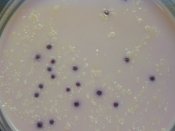
Coliform
Total Coliform

Surface Sampling Method for Total Coliform, Fecal Coliform and Enterococcus.

Sampling Procedure

  1. Measure the area of the surface to be sampled (both in the suspected area and a control in an area where low or no contamination is expected) with a tape measure and record the area in square centimetres (a 100 cm2 is recommended);
  2. Collect swab samples by removing a sterile, rayon (non-cotton) swab from a sterile tube, moisten it by inserting it into a second tube which contains a sponge soaked with sterile 1.5 mL of phosphate-buffered saline (PBS) at pH 7.2;
  3. Swab the selected surface by moving the swab back and forth across the surface with several horizontal strokes, then several vertical strokes. Rotate the swab during sampling to ensure that the entire surface of the swab was used.
  4. After sampling, return the swab to the sterile tube (with the sponge);
  5. Before collecting another sample, label the sample appropriately;
  6. On the chain of custody clearly indicate what indicator organisms you want tested, i.e., total coliforms, fecal coliforms, E. Coli and/or Enterococcus. Submit the samples to Mold & Bacteria Laboratories for testing.

Results Interpretation

Total Coliform

Coliform are found in the intestines of warm-blooded animals including human beings and hence they end up in sewage. However, they are also present in the environment as part of the natural microflora. These naturally occurring coliforms can potentially cause false positive results when testing environmental samples. For environmental samples, positive tests for total coliforms must be interpreted with caution and always be confirmed by more specific testing.

Fecal Coliform

Fecal coliform include bacteria such as E. coli, Klebsiella, Enterobacter, and Citrobacter. The fecal coliforms test is more specific than the total coliform test in indicating potential sewage contamination. However, this test is also subject to giving false negatives since these bacteria with the exception of E. coli could also be associated with plants. Therefore, as with the total coliform test, the results of the fecal coliform assay must be interpreted with caution, and positive results should be confirmed.

Escherichia coli (E. coli)

Presence of E. coli has been demonstrated to be a very specific indication of fecal or sewage contamination. E. coli has also been isolated from soil suggesting that it may not be 100% reliable indicator of fecal or sewage contamination.

Enterococcus

Alternative indicator organisms are the enterococci. The enterococci, belong to the genus Enterococcus. They are less ubiquitous than the coliform in the environment and are always present in the feces of warm-blooded animals. Although research has indicated that enterococci might be a more stable indicator of sewage contamination than E. coli and fecal coliform, some species of Enterococcus are also associated with Plants.

Conclusion.

No single indicator organism on it’s own is 100% reliable to demonstrated sewage or fecal contamination. Some experts therefore recommend use of 3 or more indicators, i.e., total coliforms, fecal coliforms, E. coli and/or enterococci.

For additional information or if you have any questions please contact us by phone at 905-290-9101.
Filed Under: Bacteria, Citrobacter, Coliforms, Enterobacter, Enterococcus, Escherichia, Laboratory, Salmonella, Shigella Tagged With: coliform, e. coli, Enterococcus, Escherichia coli, fecal coliforms, Salmonella, sewage contamination, Shigella, total coliforms

Mold Exposure Limits

Question: My question regards mold exposure limits. I just had a mold count done in my home. The spore count levels in the basement were 5X and 6X outside air in the bedroom. Are these levels high enough to make someone sick? What are “high” levels? In other words are there mold exposure limits? Molds found were Penicillium, Aspergillus and ascospores. I spent a good deal of money on the testing and just would like someone else’s point of view, other than the guy wanting to sell me the remediation. Thank you.

Answer: Due to the large number of mold species and strains commonly found in buildings and the large inter-individual variability in sensitivity to mold exposure it has been difficult to set mold exposure limits. In other words there are no safe or unsafe levels of airborne mold spore counts that have been established. In absence of mold exposure limits, results from tests for airborne fungal spores cannot be used to assess risks to the health of building occupants. However, individuals who are immunocompromised are at higher risk of mold exposure than healthy individuals.

To minimize the risks of mold exposure it’s recommended to:

  • control humidity and diligently repair any water damage to prevent
    mold growth; and
  • clean thoroughly any visible or concealed mold growing in
    residential or office buildings.

These recommendations apply regardless of the type of mold found to be growing in the building.

Filed Under: Indoor Air Quality, Public Questions Tagged With: allergy, effects of mold exposure, mold exposure, mold exposure limits, mold exposure symptoms, mold health effects, mold spores, spore counts, spores

Evaluating Mold Contamination In A Building

Question: If I want to evaluate mold contamination in a building, should I use air sampling of molds or ergosterol in dust?

Answer: The method to use to evaluate mold contamination in a building depends on the objective of the investigation and the resources available for the investigation. First let’s see what kind of data each method yields.
  • Air sampling For Mold

There are 2 methods currently used for sampling for airborne spores. These are air sampling for total fungal spore count (also referred to as nonviable analysis) and air sampling for culturable airborne fungal propagules (commonly referred to as viable analysis). The data obtained by the nonviable analysis are number of spores (or fungal elements if you include other fungal structures) per cubic meter of air. Viable analysis gives colony forming units (CFU) per cubic meter of air. Each of these 2 methods has it’s advantages and disadvantages. For example since non-viable spore analysis depends on the morphology and sizes of spores alone, identification is limited to only a few groups of fungi that have spores with unique characteristic. A vast majority of spores are reported as unidentified since it’s difficult to tell which group of fungi produced them.

The major advantage of nonviable analysis is that since the analysis does not depend on the viability of the spores, all spores present in the sample can be counted whether they are dead or alive. This brings us to the major disadvantage of analysis. If 95% of fungal structures contaminating the air were dead, this method would detected only 5% of the contamination.

The advantage of culturable sampling is that the recovered molds could be identified to species level. This is important because some important characteristics such as production of mycotoxins or pathogenicity are species (and sometimes strain) specific.

Given the advantages and disadvantages of the 2 air sampling methods, an investigator has to decide which method to use. In some cases, using a combination of the 2 methods is recommended.

  • Dust Sampling For Ergosterol

Ergosterol is the major sterol in the cell membranes of fungi (yeasts and mold). It’s present in mycelia, spores, and vegetative cells. There is a strong correlation between ergosterol content and fungal dry mass. Ergosterol content has, therefore, been widely used as an estimate of fungal biomass in various environments, such as soil and aquatic systems. Ergosterol measurements have been proposed as a new method for determination of total fungal biomass in investigations of indoor environments. One limitation about this method is that the amount of ergosterol in fungal tissue is not constant and varies with fungal species, age of the culture, developmental stage (growth phase, hyphal formation, and sporulation), and growth conditions (growth media, pH, and temperature). Another limitation is that ergosterol measurements cannot be used to determine the species present in the dust sample since it’s not genera or species specific. The method is currently not widely used and very few commercial laboratories have the capability to analyze for ergosterol in dust.

A Useful Ergosterol Reference

ANNA-LIISA PASANEN, KATI YLI-PIETILÄ , PERTTI PASANEN, PENTTI KALLIOKOSKI, AND JUHANI TARHANEN (1999). Ergosterol Content in Various Fungal Species and Biocontaminated Building Materials. APPLIED AND ENVIRONMENTAL MICROBIOLOGY, Vol. 65, No. 1: 138–142.

Filed Under: Indoor Air Quality, Public Questions Tagged With: air sampling, dust, ergosterol, indoor air quality, mold

Crawlspace Mold Growth

Question: I have an 8 year old home in BC’s Gulf Islands. On a recent trip into my crawlspace noticed some mold growth or fungus on the underside of the vapor barrier that is applied over the earth in the crawlspace. There is no sign of any mold growth elsewhere. The crawlspace has four vents that have been opened all summer, and I see no moisture in the crawlspace except some water droplets probably condensation under the vapor barrier. The concrete walls of the foundation are insulated and the crawlspace is correctly vented. Should I be concerned, should I close the vent’s over winter, or is there anything else I should do to stop this.

Thanks.

Answer: If you only noticed minor mold growth on the underside of the vapor barrier, you don’t have to be concerned. However, I would suggest you continue monitoring the entire crawlspace and if you see mold growing on wood, it’s an indication that the crawlspace is damp enough to support mold growth. In that case I would recommend that you consult a professional experienced in building foundation to determine the cause of dampness and how it may be rectified. As long as the the crawlspace is damp there will be mold growth.

Filed Under: Fungi, Indoor Air Quality, Public Questions Tagged With: crawl space, crawlspace, mold growth

Mold In The Crawlspace: Is It The Source of Strong Mold Smell?

Question: Could we be having mold in the crawlspace? I just moved into my apartment in June and I am surrounded by trees and I have a crawlspace. Well, I smell a strong mold smell in my Kitchen, bath and bedroom and they are along the same wall. I suspect the smell could be due to mold in the crawlspace. I have had several people tell me that they smell mold and I need to get it checked. My elderly mother lives with me and if I have a problem then I want to know how to deal with it. I am a renter and I did contact my landlord and he said that he would send someone out, but that’s been two weeks ago. And the first time that I complained, he told me that the vents were closed and the smell should go away but it’s still there.. I need some advice, please.

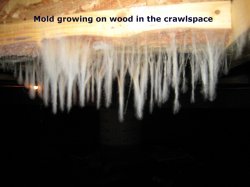
Mold in the crawlspace
Mold growing on wood in the crawlspace

Answer: Mold in the crawlspace or basement often relates to improper drainage that leaves standing moisture under a property. Checking for and removing mold in the crawlspaces of your home is a good preventative measure. Mold is believed to play a part in numerous health problems, including allergy symptoms like watery eyes and skin rashes, disorientation, dizziness, respiratory conditions and headaches. Though the living spaces are isolated from the crawlspace, mold in the crawlspace produce small spores that could be carried in air currents, rising up into the living area. The strong moldy smell that you’re experiencing is highly likely being caused by microbial growth and it’s an indication of moisture problems. You may have to continue talking to your landlord so that they could bring in a professional to determine where the mold is located and the source of moisture and give recommendations on how to correct the problem. The extent of mold growth, if any, should also be determined and an appropriate level of mold remediation recommended.

Filed Under: Public Questions Tagged With: crawlspace, mold growth, mold in the crawlspace

  • Page 1
  • Page 2
  • Page 3
  • Page 4
  • Go to Next Page »

sidebar

Blog Sidebar

Is Mold Making You Sick?

Is mold in your house making you sick?

Is mold in your house making you sick? This kind of a question would arise if someone suffers from persistent symptoms such as sneezing, runny noses, red eyes and skin rashes that seem to lessen or disappear when the person is not at home. The situation maybe complicated by the fact that only one member[Read More]

Footer

Important Links

  1. Refund Policy.
  2. Privacy Policy.
  3. Terms & Conditions.
  4. Frequently Asked Questions.

Online Courses at Glance

  1. Fungal Spore Identification Course.
  2. Mold Inspection, Identification and Control.
  3. How To Interpret Mold Test Results.
  4. How To Take Mold Samples.
  5. Mold Inspection Business Course.
  6. Online Legionella Training Course.

Testing Services and Products

  1. Cannabis Testing
  2. Mold Testing
  3. Bacteria Testing
  4. Legionella Testing
  5. Sampling Supplies

Our Location

Mold & Bacteria Consulting Laboratories
1020 Brevik Pl., Unit 1A
Mississauga, Ontario, L4W 4N7
905-290-9101