
• Skip to primary navigation
  • Skip to main content
  • Skip to primary sidebar
  • Skip to footer
  • My account
  • Checkout
  • Cart
  • Courses
  • Book a Consulting Session
Dr Jackson Kung'u- Mold Specialist

Dr Jackson Kung'u- Mold Specialist

Helping People Resolve Mold Problems

Contact Us

Dr. Jackson Kung’u (PhD)- Mold Specialist.
Phone: 905-290-9101
Mobile: 437-556-0254

  • Home
  • About Me
  • Courses
  • Consulting Services
  • Book a Consulting Session
Home | Jackson Kung'u

Jackson Kung'u

White Mold Picture

We received this amazing picture showing white mold growing on wood in a crawlspace from one of our site visitors. We wish to thank them for giving us permission to use the picture for training people about mold. For confidentiality reasons we will not mention their names here. The picture was taken from the crawlspace of a new building which has a wood basement floor and wooden joists with a crawlspace under. The crawlspace was lined with poly vapor barrier and gravel poured over the poly to hold it in place. Unfortunately, prior to roofing, it rained and the water collected on top of the poly, creating a “pool” of water over the poly/gravel and under the wood floor.
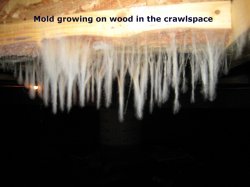
White mold on wood in the crawlspace

The pool of water sat in this confined space with no air movement and no drainage until power was connected and a pump could be placed in the sump to pump it out. In approximately 8 – 10 weeks, the white mold began to grow. When it was first noticed, it varied in length from 1/4″ in length to 1″ and covered approx. 25% of the wood joists. Within 2 weeks, it had grown from 1 inch to 4 inches in length (approx. 4 times!).

What could the white mold be?

From the picture, it’s difficult to tell for sure. However, there are a number of common wood-rotting fungi that infest damp or water-damaged wood. We shall discuss this in detail in the next post.

Could this mold be a health hazard?

Probably not. However, if it’s not completely removed, it could destroy the wooden joists completely thus compromising the structural integrity of the basement floor.

Filed Under: Fungi, White Mold Tagged With: White mold

Mold Resources

Below are some of the most common referenced mold documents.

Directory of Mold Testing Professionals and Companies

Directory of Canadian companies offering mold testing services, searchable by province and city.

Mold Articles

Limitations and Considerations in Air Sampling, Sample Analysis and Result Interpretation for Airborne Mould Spores
. Inoculum, September 2004.

Guidance for Clinicians on the Recognition and Management of Health Effects Related to Mold Exposure and Moisture Indoors
The University of Connecticut and USEPA
Fungal Contamination in Public Buildings: Health Effects and Investigation Methods
Health Canada – This document is a revision of an earlier version published by Health Canada and the Federal-Provincial Advisory Committee on Environmental and Occupational Health (CEOH) in 1995.

Mould Guidelines for the Canadian Construction Industry
Canadian Construction Association (CCA) – Recent rerelease of CCA 82. Hard copies can also be purchased from your local construction associations.

Guidelines on Assessment and Remediation of Mold in Indoor Environments
New York City Department of Health and Mental Hygiene

Filed Under: General Tagged With: Mold guidelines

Common Molds In Historic Buildings

Old, dusty and damp historic buildings provide perfect conditions for mold growth. In such buildings mold will be found growing on wall surfaces, the ceiling and on interior decorations.

Before any restoration work, it’s important to conduct a microbiological investigation to document the types of microorganisms present and their quantities. Some of the common molds in historic buildings include:

  1. Aspergillus niger
  2. Aspergillus flavus
  3. Aureobasidium pullulans
  4. Chaetomium globosum
  5. Cladosporium spp
  6. Fusarium spp
  7. Penicillium spp
  8. Stachybotrys spp
  9. Trichoderma spp

These molds are not only allergenic (trigger allergic reactions) but also potential producers of mycotoxins. For example, Aspergillus flavus is a producer of the highly carcinogenic (cancer causing) Aflatoxin. Restoration workers are, therefore, exposed to allergenic molds and also most likely to mold toxins.

Filed Under: Aspergillus, Aureobasidium, Chaetomium, Fungi, Fusarium, Penicillium, Stachybotrys, Trichoderma Tagged With: historic buildings, mold, mold toxins

One-day Mold Training Course

The mold training course is being expanded to include a full-day mold remediation training. The first day of the course will primary focus on how to recognize indoor mold, how to develop effective sampling strategies, and how to interpret laboratory results. The second day will dedicated to how to perform effective mold remediation/abatement. Dates for this unique mold training course will be posted soon. The course has not been expanded as yet but we’re still exploring the possibibilities of provinding a 2 days course.

To register for our one-day course, click booking calendar.

Filed Under: Training Tagged With: course, Mold training, training

  • « Go to Previous Page
  • Page 1
  • Interim pages omitted …
  • Page 21
  • Page 22
  • Page 23

sidebar

Blog Sidebar

Is Mold Making You Sick?

Is mold in your house making you sick?

Is mold in your house making you sick? This kind of a question would arise if someone suffers from persistent symptoms such as sneezing, runny noses, red eyes and skin rashes that seem to lessen or disappear when the person is not at home. The situation maybe complicated by the fact that only one member[Read More]

Footer

Important Links

  1. Refund Policy.
  2. Privacy Policy.
  3. Terms & Conditions.
  4. Frequently Asked Questions.

Online Courses at Glance

  1. Fungal Spore Identification Course.
  2. Mold Inspection, Identification and Control.
  3. How To Interpret Mold Test Results.
  4. How To Take Mold Samples.
  5. Mold Inspection Business Course.
  6. Online Legionella Training Course.

Testing Services and Products

  1. Cannabis Testing
  2. Mold Testing
  3. Bacteria Testing
  4. Legionella Testing
  5. Sampling Supplies

Our Location

Mold & Bacteria Consulting Laboratories
1020 Brevik Pl., Unit 1A
Mississauga, Ontario, L4W 4N7
905-290-9101