
Coliform testing is routinely used as an indicator of sewage contamination. Sewage contamination is a concern because it may contain potentially infectious organisms such as such as Escherichia coli, Salmonella, and Shigella. Exposure to sewage contamination increases the risk of gastrointestinal infections and other related illnesses. Sources of sewage contamination may include raw sewage overflows, severe flooding and leaking sewer lines or septic tanks.
To determine the potential health risks from sewage contamination swab samples could be collected and tested for sewage contamination indicators. Indicator organisms include Total Coliform, Fecal Coliform and Enterococcus.
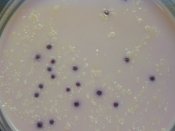
Surface Sampling Method for Total Coliform, Fecal Coliform and Enterococcus.
Sampling Procedure
- Measure the area of the surface to be sampled (both in the suspected area and a control in an area where low or no contamination is expected) with a tape measure and record the area in square centimetres (a 100 cm2 is recommended);
- Collect swab samples by removing a sterile, rayon (non-cotton) swab from a sterile tube, moisten it by inserting it into a second tube which contains a sponge soaked with sterile 1.5 mL of phosphate-buffered saline (PBS) at pH 7.2;
- Swab the selected surface by moving the swab back and forth across the surface with several horizontal strokes, then several vertical strokes. Rotate the swab during sampling to ensure that the entire surface of the swab was used.
- After sampling, return the swab to the sterile tube (with the sponge);
- Before collecting another sample, label the sample appropriately;
- On the chain of custody clearly indicate what indicator organisms you want tested, i.e., total coliforms, fecal coliforms, E. Coli and/or Enterococcus. Submit the samples to Mold & Bacteria Laboratories for testing.
Results Interpretation
Total Coliform
Coliform are found in the intestines of warm-blooded animals including human beings and hence they end up in sewage. However, they are also present in the environment as part of the natural microflora. These naturally occurring coliforms can potentially cause false positive results when testing environmental samples. For environmental samples, positive tests for total coliforms must be interpreted with caution and always be confirmed by more specific testing.
Fecal Coliform
Fecal coliform include bacteria such as E. coli, Klebsiella, Enterobacter, and Citrobacter. The fecal coliforms test is more specific than the total coliform test in indicating potential sewage contamination. However, this test is also subject to giving false negatives since these bacteria with the exception of E. coli could also be associated with plants. Therefore, as with the total coliform test, the results of the fecal coliform assay must be interpreted with caution, and positive results should be confirmed.
Escherichia coli (E. coli)
Presence of E. coli has been demonstrated to be a very specific indication of fecal or sewage contamination. E. coli has also been isolated from soil suggesting that it may not be 100% reliable indicator of fecal or sewage contamination.
Enterococcus
Alternative indicator organisms are the enterococci. The enterococci, belong to the genus Enterococcus. They are less ubiquitous than the coliform in the environment and are always present in the feces of warm-blooded animals. Although research has indicated that enterococci might be a more stable indicator of sewage contamination than E. coli and fecal coliform, some species of Enterococcus are also associated with Plants.
Conclusion.
No single indicator organism on it’s own is 100% reliable to demonstrated sewage or fecal contamination. Some experts therefore recommend use of 3 or more indicators, i.e., total coliforms, fecal coliforms, E. coli and/or enterococci.
For additional information or if you have any questions please contact us by phone at 905-290-9101.


 Determining the effectiveness of sewage cleanup